The Sculptor's Chisel
Menu
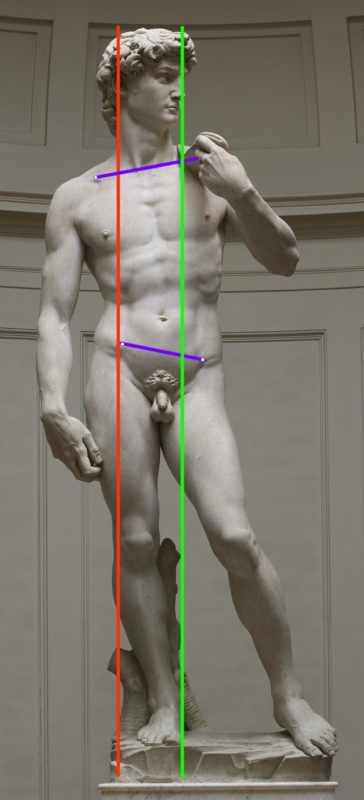
Contrapposto, (Italian: “opposite”), in the visual arts, a sculptural scheme, originated by the ancient Greeks, in which the standing human figure is poised such that the weight rests on one leg (called the engaged leg), freeing the other leg, which is bent at the knee. With the weight shift, the hips, shoulders, and head tilt, suggesting relaxation with the subtle internal organic movement that denotes life. Contrapposto may be used for draped as well as nude figures. The Greeks invented this formula in the early 5th century bc as an alternative to the stiffly static pose—in which the weight is distributed equally on both legs—that had dominated Greek figure sculpture in earlier periods.
The red and green lines represent the vertical axis as a plumb bob would respectively indicate. The purple lines represent the contraction of the waist and ribs, to the movement of both shoulder and pelvic girdles. The picture is static, so we cannot accurately see where the plumb bob would be placed.
It is standard practice to drop the plumb bob, from the tragus to the inside of the weighted angle.