The Sculptor's Chisel
Menu
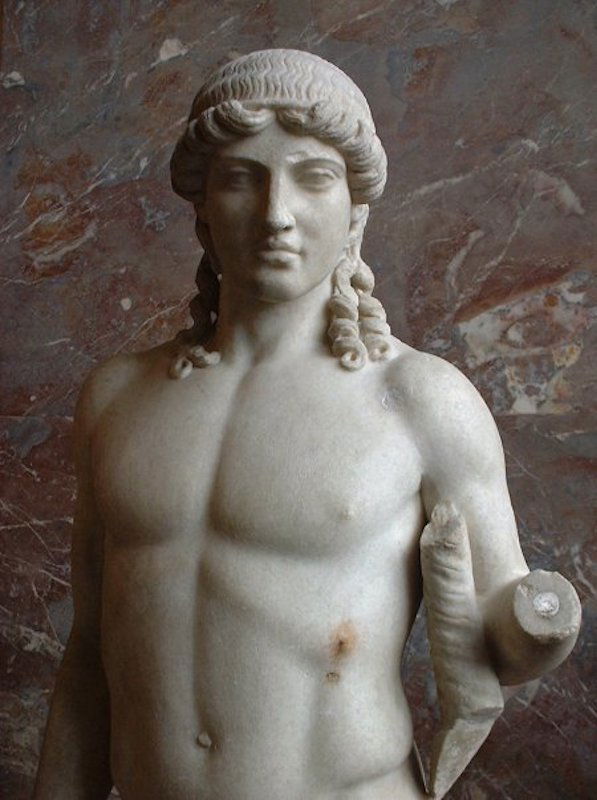
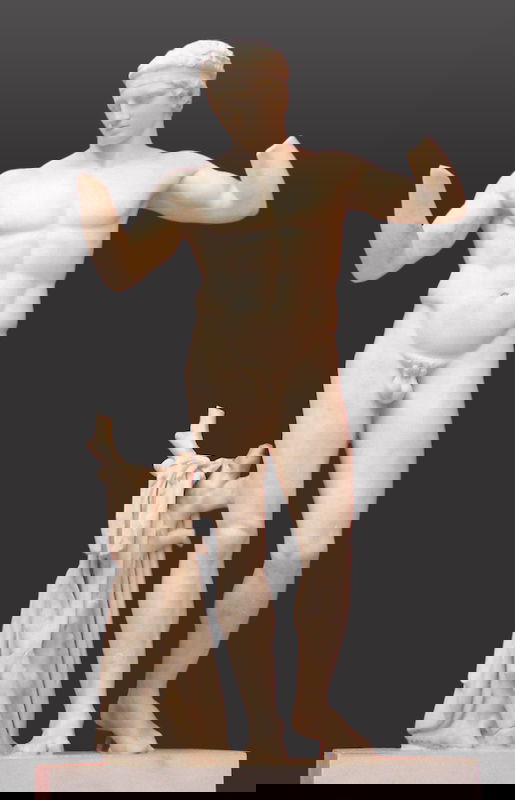
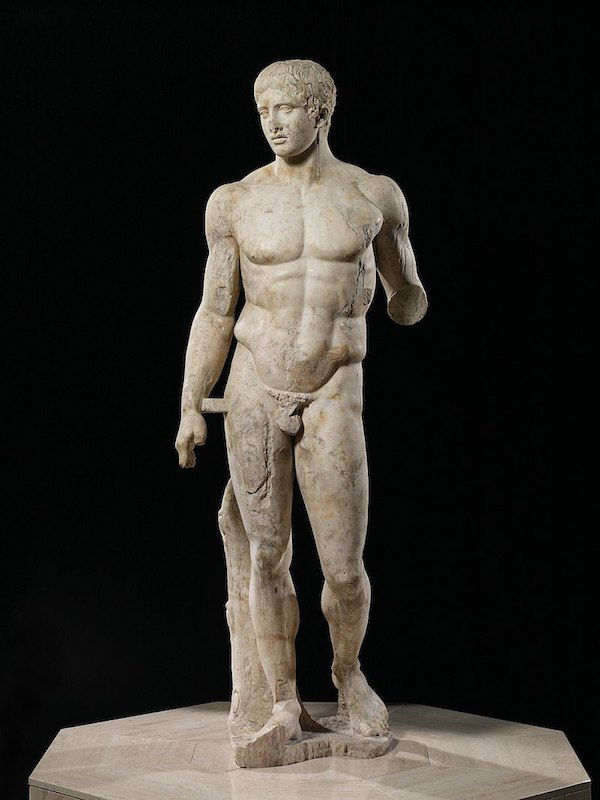
Although none of his original works survive, literary sources identifying Roman marble copies of his work allow reconstructions to be made. Contrapposto, a pose that visualizes the shifting balance of the body as weight is placed on one leg, was a source of his fame.
The refined detail of Polykleitos' models for casting executed in clay is revealed in a famous remark repeated in Plutarch's Moralia, that "the work is hardest when the clay is under the fingernail".
The Kanon and symmetria
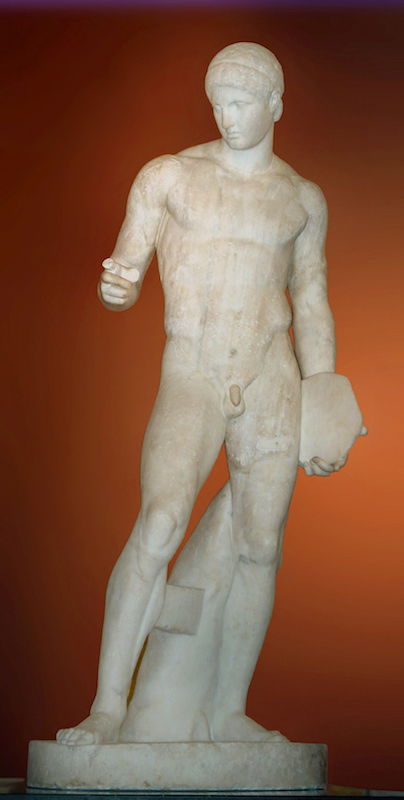
Polykleitos consciously created a new approach to sculpture, writing a treatise (Kanon) and designing a male nude (also known as Kanon) exemplifying his aesthetic theories of the mathematical bases of artistic perfection. Though his theoretical treatise is lost to history, he is quoted as saying, "Perfection … comes about little by little (para mikron) through many numbers". By this he meant that a statue should be composed of clearly definable parts, all related to one another through a system of ideal mathematical proportions and balance. Though the Kanon was probably represented by his Doryphoros, the original bronze statue has not survived, but later marble copies exist.
References to the Kanon by other ancient writers imply that its main principle was expressed by the Greek words symmetria, the Hippocratic principle of isonomia ("equilibrium"), and rhythmos. Galen wrote that Polykleitos' Kanon "got its name because it had a precise commensurability (symmetria) of all the parts to one another." He also wrote that the Kanon defines beauty "in the proportions, not of the elements, but of the parts, that is to say, of finger to finger, and of all the fingers to the palm and the wrist, and of these to the forearm, and of the forearm to the upper arm, and of all the other parts to each other."
Contemporary scholar Kenneth Clark observed that "[Polykleitos'] general aim was clarity, balance, and completeness; his sole medium of communication the naked body of an athlete, standing poised between movement and repose". Others have theorized different ways Polykleitos' system may have worked. One suggestion is that his method started with one body part, such as the last (distal) phalange of the little finger, treated as one side of a square. Rotating that square's diagonal gives a 1 : √2 rectangle, suitable for the next (medial) phalange. The method could have been repeated to get the next phalange, then (using the whole finger) to get the palm; then using the whole hand to get the forearm to the elbow, then the forearm to get the upper arm.