The Sculptor's Chisel
Menu
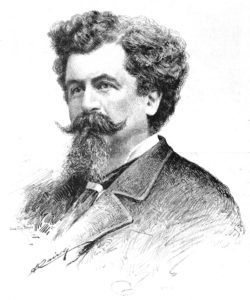
He was born in Milan on February 10th, 1839 by Carlo and Giuseppina Gioli; he had his first experiences in the studies of A. Puttinati and A. Tantardini. In modeling the statue ( Fama or Italy ) that Tantardini added to the monument of Cavour, in Milan, it is already believed to recognize the intervention of the young artist.
Education
At the sculpture school of Brera he studied with G. Strazza and B. Cacciatori, also under the influence of V. Vela. It had a first success with the group of Hercules and Antaeus (1856) and obtained the government prize for sculpture in the competition held by the Brera Academy in 1859 with Ecce homo and a second time in 1864 with Giuditta (gessi at the Modern Art Gallery from Milan). He had authoritative acknowledgments when he performed (1863, '65, '67) the statues of S. Ilario , S. Venceslao and S. Adelaide for the Fabbrica del Duomo. Exposed in a group of twenty-three statues entrusted to the artists judged the best of the time (among them the old Sangiorgio), they had the praises of the severe Mongeri, who also judged those sculptures "inappropriate" to the Gothic cathedral.
He received more support in Paris, where he exhibited in 1867 Frine and Amore blind . He treated the genre sculpture with equal luck, which he alternated with monumental works, such as Giuseppe Verdi (1881) in the atrium of La Scala; Manzoni (1883) in Piazza S. Fedele in Milan (statue hit by airstrikes in 1943, but happily reassembled); the statue of F. Hayez (1890) in the small square flanked by the Brera palace; that of L. Manara in public gardens in Milan (1894); the monument to Nicolò Tommaseo in Venice (1882); the monuments to Vittorio Emanuele II in Genoa and Bergamo (in collaboration with L. Pagani); the statue of Garibaldi in Crema; that of King Vittorio in Lodi (1883).
His major work was the monument to Napoleon III in the park of Milan (1881-1884); the statue, for oppositions of a political nature, was confined, almost forgotten, in the first courtyard of the Senate palace, and only in 1927, in consideration of its recognized value, had its current location.
It should also be remembered, of B., also his work as a teacher (from 1880 to his death), from the sculpture chair of Brera. 31 Ag. Died in Precotto (Milan) 1892.
Gaudy and often elegant modeler, in the manner of Lombard pictorialism, treated marble and bronze with equal virtuosity. His art took place without repentance, without deviations, in the style of tenuous verismo already defined in his early works, without concessions to those new trends that were affirming at the end of the last century.
His son Prassitele was born in Milan on 8 July 1880. When his father was only twelve years old, he grew up at the school of Enrico Butti, obtaining (1908) in the final essay the Oggioni pension. He won the Tantardini award with the Sola statue in the world . Ten years later, with the Elegia statue, he obtained a gold medal from the Ministry of Education.
In the footsteps of the Butti, which he helped for three years and in accordance with the Lombard tendencies of the time, inclined to an art of humanitarian subject, but corrected by a breath of poetry and a composed grace that is influenced by the
He is the author of portraits, of small sculptures, of medallions, of numerous funeral monuments at the Monumentale di Milano, among which the beautiful marble of a praying Fanciulla on the tomb of the Gussoni family is to be treated.
[/section] [section] [button text="SCROLL TO TOP" style="underline" link="#top"] [/section]