The Sculptor's Chisel
Menu
Myron (active 480-440 BCE)
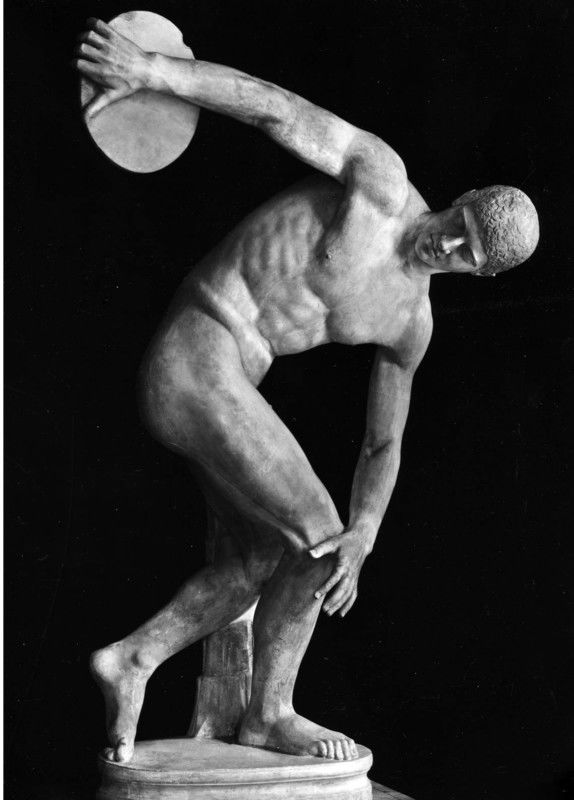
Myron was one of the greatest sculptors of Early Classical Greek sculpture. He was famed for his sculptures of powerful athletes and life-like animals. He produced mainly bronze sculpture and was considered a versatile and innovative artist in his time. His most famous statue, which exists only in the form of copies by Roman artists, is the famous bronze figure of a disc thrower known as Discobolus (c.425 BCE).
Biography
Born in Eleutherae, a small town on the ancient borders of Boeotia and Attica, Myron lived most of his life in Athens. Little is known of his life, and what we do know, comes from ancient literary sources - primarily from the 1st century writer Pliny. According to Pliny, Myron absorbed the art of sculpture from Ageladas of Argos - the same teacher who taught both Phidias (488-431 BCE) and Polykleitos (5th century BCE). Pliny wrote that Myron was the first to achieve life-like representations in figurative sculpture. However true this statement is, it is fair to say that Myron mastered his craft and was gifted in his ability to create movement, harmony and naturalism.
Myron's major period of activity was during the period of time following the Greek victories over the Persians in 480-79 BCE, when commissions were rife. His statues are said to have been scattered throughout the Greek world with some concentrated in the Acropolis in Athens. As far as is known, Myron worked exclusively in Bronze, except for one statue of Hekate, which was forged in wood.
Discobolus: The Discus-Thrower
Although Myron sculpted representations of gods and heroes, he became famous primarily for his representations of athletes. Discobolus, was a representation of a disc-thrower - Myron captured the moment when one movement is completed and the athlete pauses for the next - he has just completed his backswing, his arm is outstretched and he is about to commence the forward swing.
The work was widely admired for capturing the instability of an instant motion and combining it with a composition of balance and harmony. The statue was designed within a single plane, which means it was only meant to be seen from the sides. The original no longer exists but there is an excellent marble copy, made in Roman times, now housed at the Museo Nazionale Romano, Rome. Pliny also mentions a bronze casting of Ladas the Runner (c.476 BCE), an athlete who fell dead at the moment of victory. He was an Olympic winner of the footrace and was depicted poised on tiptoe at the start of the race. No copies have been identified. Another popular work was that of Lycinus (c.448 BCE) an Olympiad winner.
« Back to Glossary Index